Tuesday, 6 December 2016

Waiting for the Boat


By Frieda
While we waited for the boat to Mananara we visited an open air concert of a madagascan pop star called Dadi Love. It was a very good and happy atmosphere at the concert and we could take part in  the enthusiastic way of a madagascan celebration J.

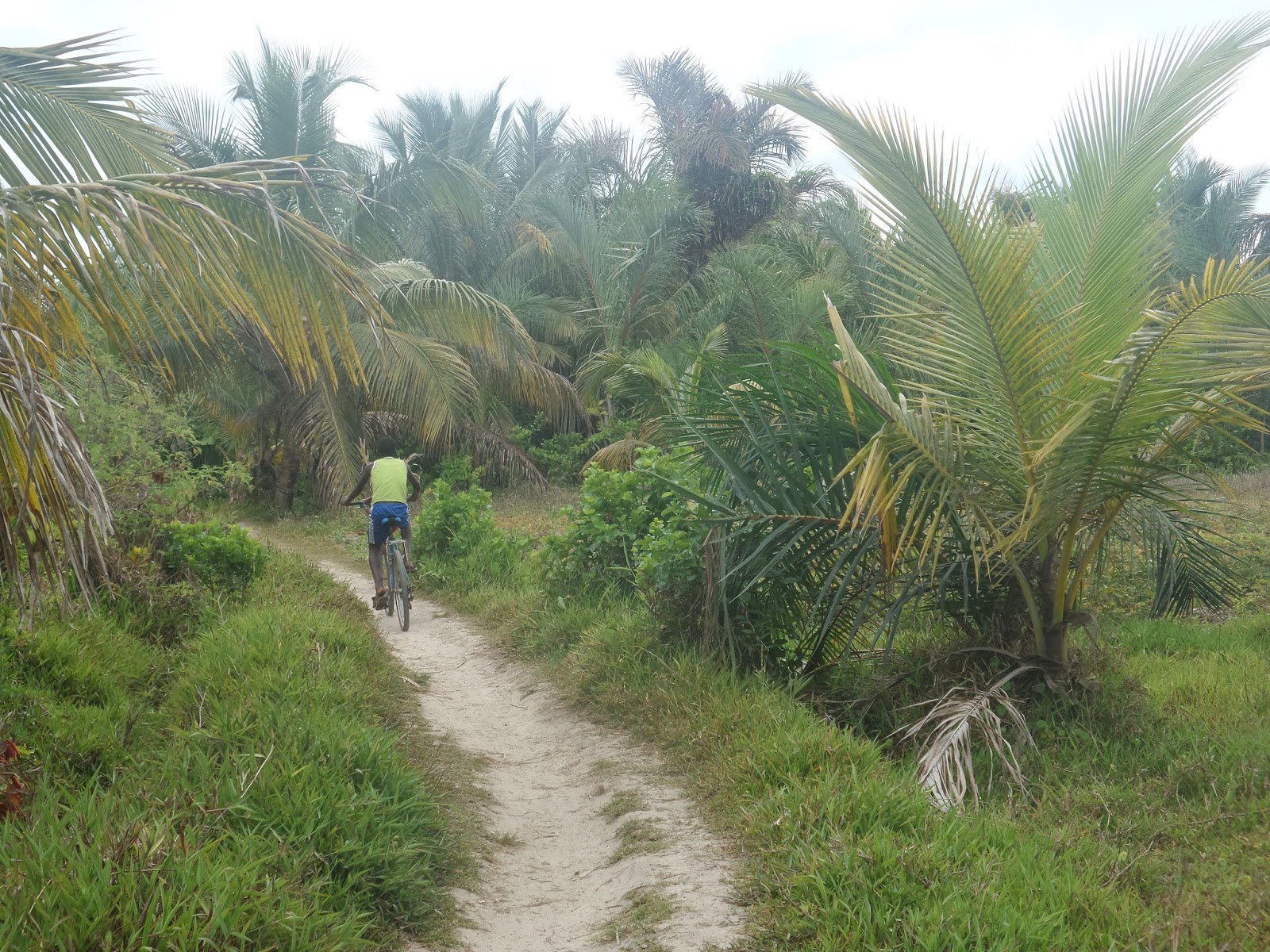
The day after that a local farmer invited us to see his farm. Therfore we walked one hour to the opposite site of Sainta Marie. The walk was amazingly beautyful, passing rice fields untouched nature and some small villages. Everywhere friendly people were greeting us as we passed them, sometimes amused that we knew how to greet in the madagascan language.

The Farm was a compound of 50 square metres full of coconut trees, vanilla- and maniok plants, located directly at the beach. His house was a very basic hut, of course with neither running water nor electricity. He makes a living of his plants and some fishing. In the evening he told us that he loved to listen to soap operas on the radio. The basic life and the positive attitude of  this guy impressed us very much and we felt very honured to be his guests. While having one of his exceptionally good coconuts we enjoyed the beauty and calmness of the place.

We stayed so late that we had trouble to get back to the other side of the island before it would get dark. While we hurried down the path several cars with white people passed by without taking any notice of us (we got the impression that Sainte Marie is rather full of old french man moving to the island or visiting it to mate up with rather young madagascan women. Nowhere else in Madagascar we saw so many of those rather unfriendly kind of european people). But the one car driven by young madagascan boys offered us immidiately a lift back to town. Arriving there they invited us to hang around with them later on.

When we met them a few hours later they took us to a very nice spot an the beach to have some drinks with them. Listening to madagascan music we talked about life in Madagascar and in Germany. (they would not even give us a chance to pay for anything). The whole day was a very nice experience of madagascan hospitality.

From Addis to Arba Minch


By Frieda
Our plan was to go to Shashamane, a city which is supposed to be a very relaxed nice place close to large lakes and some sites in the nature and also home to Ethiopia’ Rastafarian community. We arrived there by local bus in the evening but Shashamane did not show its nice side to us. We could not prevent beeing “guided”, so two guys brought us to a hotel. But as we found out a little later that it was not the one we wanted to go to. Their “service” took them around 10 minutes and they wanted too much money for that. Not that alone, but the demanding and unfriendy and rather agressive habit in which they treated us made the situation very uncomfortable. And also the owner of the hotel tried to convince us to give them more money which I found very unappropriete as well.

A little later we realised that they had not even brought us to the right hotel. The place we were stranded now turned out to have neither light nor running water. The whole situation and our own stupidity of course annoyed us so much that we decided not to give that city a second chance. We left in the early morning before dawn and took the bus to Arba Minch a city further down in the south.

Early the next morning we took a minibus to Sodo (100 Birr) and then changed on a bus to Arba Minch (75 Birr), where we arrived in the afternoon.

From Lalibela to Addis


By Frieda

In the evening we went to the bus station to get some information on how to get best to Addis the next day. It seemed like the the best idea is to take the local bus to Woldia and then hope to catch a minibus to Addis. We were not sure if we could make it in one day and prepared to stay maybe one night in Woldia.

However, early the next mornig someone knocked on our door to tell us our taxi had arrived. Even though we did not arrange anything we got down to see a fancy jeep waiting in front of our hotel for us. A few locals explained to us that this car would go to Addis in one day and this would be what we would want. And in this point he was right J we thought quickly about it and decided that 800 Birr was the maximum that we were willing to pay altogether and that they could either take it or we would take the local bus. They wanted 1000 Birr and we agreed.

In the bus were already three people and the driver. The two of us cramped to the two other people on the back seat and started our journey. This was around 5:30 in the morning. Around 12 hours and several stops later we arrived after dusk in Addis and were very happy that we could have made it in only one day. By public transport you must be very lucky to make it in one day, it might even be impossible.

From Bahir Dar to Lalibela


(6 am bus to Weldiya, get off at Geshena (5h), change into the bus or anything else to Lalibela (6h), altogether around 250 Birr)

By Frieda

To get from Bahir Dar to Lalibela we had to start very early in the morning. It is a very long way and we hoped to be able to do it in one day. The evening before we met a “nice” guy who was promising us a good connection going directly to Lalibela. Even though we knew better we trusted him after a while. We were chatting with him for a little time and he managed to compliment us in a way that we thought it was worth giving him a chance of convincing us that being suspicious was not necessary. For example he was very interested in Daniels political views and impressed by his knowledge of the political situation (even though he scammed us i still think he was impressed). When he told us that we had to pay in advance we told him that we never do that but as i said before we wanted to give it a chance and paid 100Birr in advance (he wanted the full price of 500Birr) knowing of the possibility to just lose the money. The next morning, surprisingly, someone actually came to pick us up but instead of bringing us to a direct private transport he took us to the local bus we wolud have taken anyway. So the 100Birr were lost as expected and with them my hope of people being nice for the sake of itself if they also want to sell you something.

I like travelling by local bus. In one bus fit around 70 people crammed into small rows of seats. Even though you have very little space I consider it rather comfortable and I can sleep there pretty well. For Daniel with his long legs it is a bit less nice but he is never complaining. The bad thing about the local bus is that it is very slow. The roads are often bad. Either dirtroads or asphalted roads with huge holes in them. On the plus side you see a lot of Ethiopia’s beautyful countryside, villages and small towns if you travel slowly by bus. And for my experience sooner or mostly later you get where you want to go.

On this trip we arrived around noon in a small village where we had to change buses. But before we could get to the bus to Lalibela a truck driver offered us a ride for 100Birr. We accepted because we liked the idea of trying out another vehicle for a change. So we sat in the truck’s cabin for the next five hours. But after 20 minutes the truck stopped to load some more stuff which could not fit into another truck waiting by the roadside. Daniel helped to load and then we drove for hours on a very very bad road (it was in such a bad condition that I was happy we did not take the local bus) through a scenic lndscape up and down through hilly sorroundings. During dusk we finally arrived up in the mountain city Lalibela.

Bahir Dar


By Frieda
We went from Gondar to Bahir Dar by minibus. It took about 4 hours and cost us 200 Birr.

The road is apparently dangerous at night but we travelled during the day and reached Bahir Dar before nightfall.  We tried the first Hotel we saw when we got off the minibus. The hotel had a reasonable price (200 Birr) and the rooms were perfectly fine for us. Clean and with a working shower. It even had a TV.

After we checked in we strolled a little around town and found us a local place where we could get Shekelau Tibs. This dish is medium sized pices of beef served in a sizzeling pot with glowing coal under it so that the meat stays hot while you eat.

The next day we wanted to go to the lake Tana which borders the city. We took a boat tour to see a few of the monestaries located on islands on the lake and its shores. As almost everywhere in Ethiopia a ”guide“ found us in our hotel, offering exactly what we were looking for. He offered a reasonable price so we took his offer (200 Birr per person). We went with him to the lake but arriving there he told us that unfortunatly the boat was not full because he could not find other tourists to take the tour with us. Just one person and therfore it should be 200 Birr more for the two of us. We were not willing to pay but preferred to wait for more tourists. But after a while of waiting we agreed to pay the higher price. But we had not enough money on us so we agreed to pay the difference in the evening. In the end the boat was rather full but only one other farangi was on board.

The boat took us over the lake to a close peninsula for a visit of about an hour. The water of the lake had a muddy brown colour which is typical for lakes and rivers in Ethiopia. On the peninsula were three monasteries. The way up to the first one was clustered with stalls of souvenirs for tourists. They had scarfs, religious pictures, lunchboxes made of goat fur and some neklaces. Instead of having a look at the first monastery we headed for the second one further inside of the peninsula. But even though we followed the marked path we couldnt find it. But it was a nice walk in a jungle-like landscape. On our way we saw several kinds of monkeys and beautiful birds. When we came back to our boat everyone was already waiting for us. Apparently they had just visited the first monatery and went directly back to the boat afterwards.

We left the peninsula and the boat rode to a small island close by. Here women where not allowed to the monastery so I waited by the boat.  Our boat driver gave us some fruit he picked from a tree I had never seen before. It was small like a walnut had a lilac skin, white flesh a big stone in the middle and tasted  very sour.

From the island we crossed the lake to its right side where the Blue Nile flows out of the lake. This took us about half an hour. In this spot were supposed to live hippos. And really we could see the head of a hippo emerging from the water serveral times relatively close to our boat. The head was huge and i was surprised how long the hippo could stay under water without breathing. After that we headed for our starting point an the bank of the lake. The hippo was really my day’s highlight.

Thursday, 1 December 2016

Piscine Naturelle


Ile aux Nattes

By Frieda
After two nights in Ambodifotatra, the capital of Ile Sainte Marie, we made our way to Ile aux Nattes a small island south of Sainte Marie. The tuk-tuk ride cost us 15 000 Ar to get to the southernest spot of the Island. From there we took a pirogue directly to the hotel we wanted to stay in, “Chez Sica” (35 000Ar.). Again we payed too much J. We knew it should be 10 000 but the pirouge charged us 20 000Ar. but we were so impressed by the beauty of the island that we did not negotiate J.
We had a very basic bungalow but it was very well kept and we did not mind that the bathroom was outside. The island is one of the most beautiful tropical islands that i have ever been to. It is not long that it has been discovered for tourism and therfore very pure. But still the beach is already rather full of bungalow places. Inside the island you have amazingly beautiful walks trough junglelike forests and some very small villages. There is even a nice lighthouse from where you can overlook the whole island. Also, walking on the beach is great as you are usually quite by yourself surrounded by nothing but sand, the sea and coconut palms.
Our plan was to relax on Ile aux Nattes because travelling can be exhausting after a while ;). This plan perfectly worked out. We did nothing but reading, sleeping and snorkling. In front of “Chez Sica” is a nice reef you can reach at high tide. Sometimes in the afternoon we walked a little bit around the island.
We were also very happy about the bungalow place having an open kitchen where you could cook for yourself. In the kitchen we befriended Judith, a women living in the nearby village, who had a job as a chef for one week at “Chez Sicas”. She was very very sweet always explaining what she was  cooking and sometimes helping us. For example she showed us how to make an excellent pulp salad which we ate almost every day after that J. Communicating with Judith was epecially for me difficult (I dont speak French and hers wasn#t good either) but we still tried and used hand and feet always laughing when we did not understand each other. So we had a lot to laugh about in the kitchen.
Every morning we walked 15 minutes into the village to buy bread for breakfast and vegatables for cooking in the evening. We loved the village very much and because we came every day people in the village knew us and greeted us very friendly. They even started to ask us about news (the local way to do small talk).
We also found one shop with a very nice and (as we called him) “honest tradesman” who would not give us extremely exaggerated prices and could get us everything we wanted within a few hours. Here we retuned every day for fresh eggs and freshly caught pulp. All together we had an amazing relaxing time on Ile aux Nattes and our hearts felt a little bit heavy when we had to leave.